Rede
Reviver is a cooperation network which started
its activities in January 2000 as of having a
proposal approved by edict 01/97 of FINEP and
FAPESB (Fundação de Amparo a Pesquisa
do Estado da Bahia – Foundation for Research
Support of Bahia State), regarding the Program
of Development of Engineerings-PRODENGE- subprogram
Cooperative Networks of Research - RECOPE.
General
Objectives and Operation
REDE
REVIVER integrates: University, private, public
and research institutions, looking for solutions
of problems originated by the development process
itself, such as the production and destination of
residues.
The
more developed is the community, more is its production
of residues and more is the risk of degradation
and environmental impacts. The creation of this
network aims to congregate efforts in order to propose
an integrated management of tecnologies regarding
the solution of waste problematic, developing activities
of environmental education, sensitization of communities,
assistance in the implementation of selective collections
and composting plants, processing of organic residues,
monitoring of the produced compost quality, development
of researches, which evaluate the effect of compost
on the improvement of agricultural soils, parks
and gardens and degraded areas, linking its activities
to the formation of qualified personnel and to the
prodution of employments and income.
UFBA partnership mainly with LIMPEC (Empresa de
Limpeza Urbana de Camaçari) – Camaçari
urban cleaning company, among other public and communitary
institution, such as CEPLAC-CEPEC, SPJ, EBAL, Associação
Beneficente Senhora Santana da Cordoaria, EBDA and
more recently Banco do Nordeste S.A., has been established
with the commitment to produce compost (from urban
organic residues) and evaluate its quality through
the results obtained with the development of researches.
REDE REVIVER composting plant was installed at LIMPEC
Sanitary Landfil in Camaçari. Organic residues,
from domestic wastes, from street markets and supermarkets
mixed with pruning residues of grass and trees,
are destinated to compost production. This compost
is used for the improvement of soils of degraded
areas, soils of parks and gardens, scientifical
experiments, etc. The Plant is in operation and
the compost which has been produced (about 10 tons
per month), has been used for the development of
researches together with agriculturists within Salvador
region. Soon the compost will be commercialized.
Agriculturists identified by this Netwok have been
receiving the organic compost in order to use it
on their properties, following the instructions
of the Leader Instituition (UFBA), which proceeds
a work of intensive monitoring of physical, chemical
and biological characteristics of the soil in those
areas.
SPJ – Superintendency of Parks and Gardens
of Salvador City (Superintendência de Parques
e Jardins da Prefeitura Municipal do Salvador) can
use the compost to improve parks and gardens, following
the results of researches developed in master degree
works, in a cooperation system between UFBA and
SPJ.
CEPLAC/ CEPEC and EBDA participate respectively
assisting the implementation of methodologies and
making analyses of soil, organic compost and plant
tissues, which are still not feasible at LAVIET.
In
November 2002, the itinerant course started, given
by Rede Reviver, and has as objective to diagnose
problems caused by the inadequate deposition of
residues and propose promising alternatives to the
waste problematic, making possible to the visited
communities, environmental, economical and social
gains.
| |
|
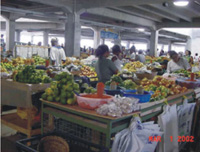
| Feira
Municipal de Camaçari-BA
|
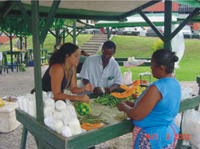
Feira
Orgânica de Camaçari-BA
|
| |
|
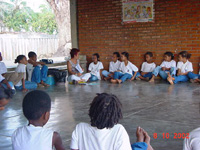
| Visita
às Escolas |
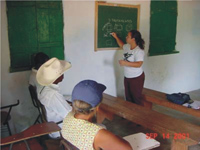
Parceria
Direta com Agricultores |
|